Building-Level Control
- Plant equipment
- HVAC operation
- Schedules
- Alarms

BUILDING CONTROL FEATURE
Turn your Koolmesh lighting network into a practical source of room-level building data.
Through the HBGW04/R gateway, occupancy, daylight, lighting status and device data can be shared with building management platforms using BACnet/IP, Modbus TCP/IP or MQTT.
THE MISSING LAYER
Building platforms may have limited visibility of what is actually happening inside rooms and occupied spaces.
Structured room-level information
The challenge is not simply collecting more data. It is making useful room-level data available to the BMS in a structured, project-ready format.
 DaylightLighting StatusOccupancy
DATA ALREADY IN THE ROOM
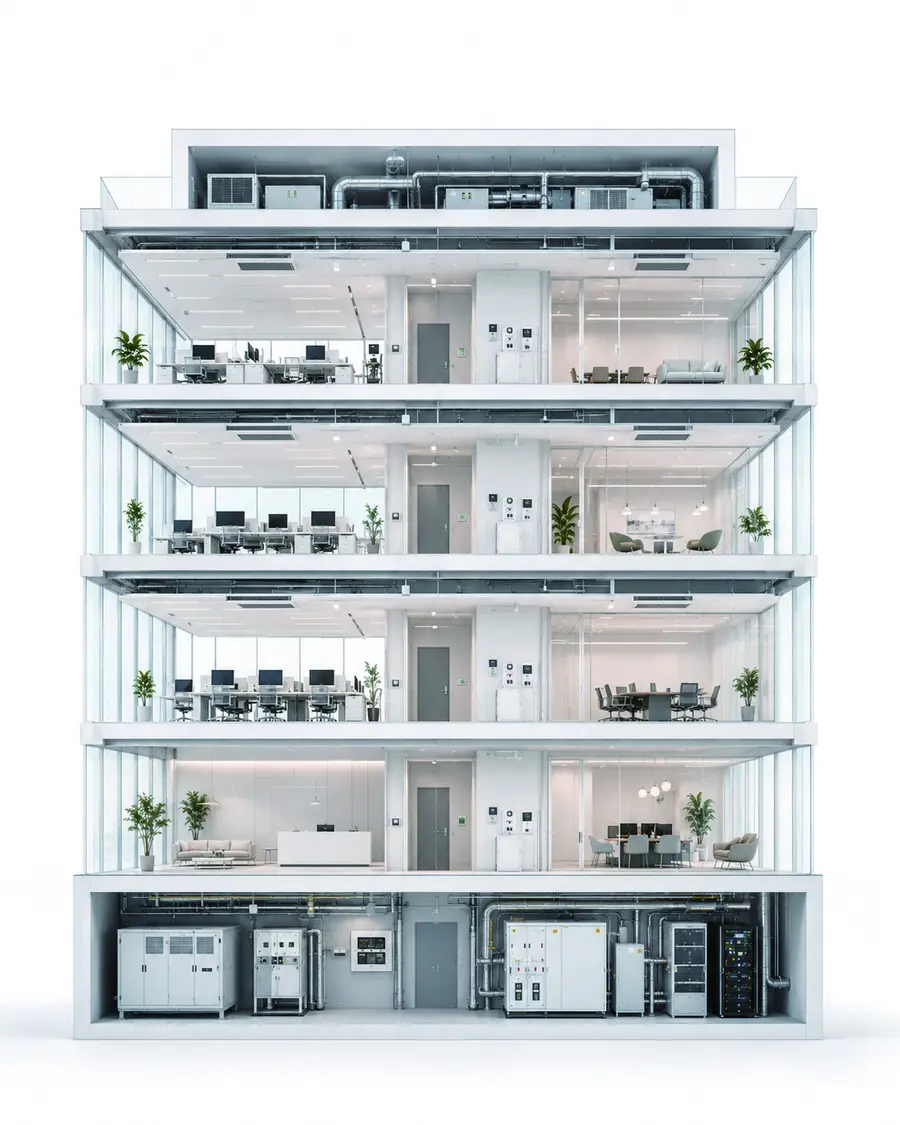
Lighting sensors are already installed in one of the most useful positions in the building: the ceiling. They are close to occupants, desks, corridors, meeting rooms, daylight and room boundaries.
With connected controls and sensors, the lighting layer can provide a practical view of how rooms and zones are actually being used.
Lighting-control infrastructure becomes more than lighting. It becomes a room-level data source for wider building operation.
THE INTEGRATION PATH
Koolmesh luminaires, controllers and sensors collect lighting-side and room-level information.
Devices communicate through the Koolmesh Bluetooth Mesh lighting network.
HBGW04/R converts devices, sensors, zones and scenes into accessible BMS data points.
The BMS uses selected data for dashboards, reporting, monitoring and agreed control strategies.

Multi-protocol Gateway



Final point lists, object mapping, writable points and integration responsibilities must be confirmed for each project.
AVAILABLE DATA
Available data depends on the connected Koolmesh devices, gateway configuration, firmware version and project requirements.
ON/OFF, dimming and CCT commands and status where supported.
Motion, presence and room or zone occupancy information.
Daylight sensor lux values and ambient brightness information.
Meter readings and cumulative consumption where available.
Identification, related control data and scene recall where supported.
Selected device, system and failure-return information where supported.
MULTI-PROTOCOL CONNECTION
HBGW04/R bridges the Koolmesh Bluetooth Mesh lighting network with building-management and supervisory platforms.
The main route for exposing selected lighting and sensor data as structured BACnet objects.
A register-based interface for compatible building and energy-management systems.
A local data-exchange route for MQTT-enabled platforms and compatible supervisory systems.
Objects, registers, topics and writable values depend on connected devices, gateway configuration and agreed project scope.
FROM DATA TO ACTION
Room or zone occupancy can help the BMS align heating, cooling or ventilation strategies more closely with actual space use.
Daylight levels and lighting operation data can support dashboards, operational review and energy-management strategies.
Selected device and fault information can be surfaced through a BMS or facility-management interface for clearer visibility.
Where configured by the BMS team, occupancy outside normal schedules can support security or operational alerts.
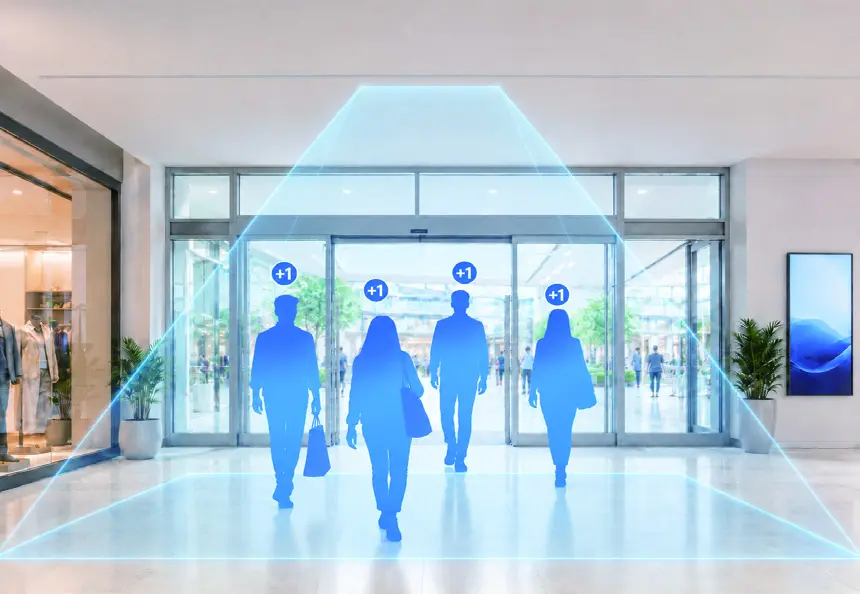
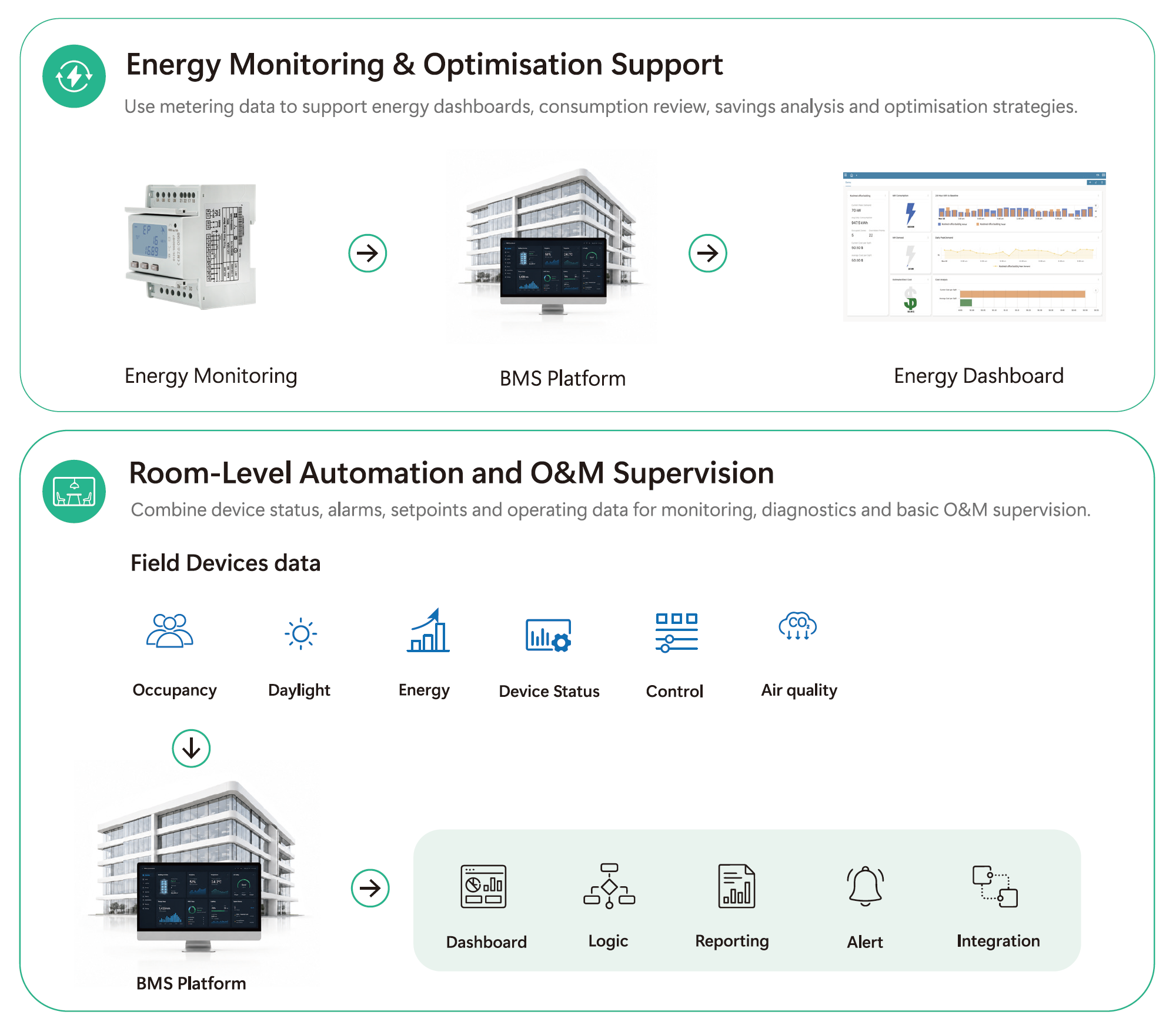
The BMS or supervisory platform determines the final logic and response. Koolmesh provides the available field data.
SYSTEM RESPONSIBILITIES
Connected luminaires, controllers and sensors collect lighting-side and room-level data.
The gateway converts selected field data into formats that can be used by the BMS.
The BMS applies dashboards, reporting, logic and facility-management interfaces.
Connected luminaires, controllers and sensors extend room-level visibility from individual spaces to wider building operation.
COMPATIBLE PRODUCTS
Choose the connected sensors, controllers, drivers and system-level components that match the data and control route required by the project.
Multi-protocol BMS Gateway
Connects Koolmesh Bluetooth Mesh lighting systems with building-management and supervisory platforms.
BACnet/IP | Modbus TCP/IP | MQTT HBIR29Built-in 80 mA DALI PSU | Tri-level Dimming & Daylight Harvest | Koolmesh App CommissioningView product
  HCD038/BTCompact Control Unit | Built-in 30 mA DALI PSU | Plug-and-Play Sensor HeadsView product
  HIR61Compact Zhaga Book 20 | Occupancy & Daylight Input | D4i Type BView product
  HBTD8200DJunction Box Installation | Bluetooth-to-DALI Conversion | Push Switch & App SetupView product
  HCD405D2Compact DALI-2 Sensor | Occupancy & Daylight Input | IEC 62386 CompliantView product
  HBTD15Zhaga Book 18 | RTC Backup | External Bluetooth AntennaView product
  HBEW8040Full-Spectrum RGBW Control | RGBW, xyY & DUV Tuning | Bluetooth Mesh ConfigurationView product
  HBEM06Maintained & Non-Maintained Operation | Battery Thermal Protection | Koolmesh App CommissioningView product
  HED8060/BT60 W Tunable White Driver | Switch-Dim & Bluetooth Dimming | DIP Switch & App ConfigurationView product
  HPAD-TSJASE1Standard Switch-Box Installation | Colour, Scene & Environment Control | App-Based CustomisationView product
  HBLM01Solar & Battery Powered | Lux, Temperature & Humidity | Bluetooth & NFC CommissioningView product
  HBKS03/WSelf-Powered Three-Button Switch | No Wiring or Batteries | Koolmesh App ConfigurationView product
 FAQ
Every project has a different BMS, network and point requirement. These answers establish the starting point.
No. Koolmesh provides lighting-side and room-level data through an integration gateway. The BMS remains the supervisory platform.
HBGW04/R supports BACnet/IP, Modbus TCP/IP and MQTT. BACnet/IP is the main route for exposing selected lighting and sensor data as BACnet objects.
Selected commands and writable points may be supported where the connected device, gateway configuration, firmware and agreed project strategy allow. The final point list and control hierarchy must be confirmed during project review.
Depending on the connected devices, available data may include lighting control and status, occupancy, daylight, CCT, energy readings, zones, groups, scenes and selected device status.
Yes, where the existing BMS is accessible and a suitable integration route is available. Network access, protocols, required data points and system responsibilities should be reviewed before deployment.
START THE CONVERSATION
Share your project type, existing or planned BMS platform and required data points. Hytronik can help review the suitable lighting devices, gateway and integration route.


 Bluetooth Mesh